Showing posts with label Blade of Takshaka. Show all posts
Friday, May 10, 2013
The Blade of Takshaka is Essentially Finished
I have completed working on my urban scenario The Blade of Takshaka for Swords of Cydoria. It's laid out, it's edited, it's illustrated. It's done!
It's 52 pages with five chapters and four appendices. It has a drawing room role-playing mystery; a thrilling chase; a dungeon crawl with a jelly-blob, a giant octopus, and albino alligators; more role-playing with a group of intelligent rats; infiltrating an evil snake cult; and an optional raid/infiltration against a well-guarded penthouse mansion!
The only thing I haven't done is playtest it. Playtesting it might result in a future revision of some monster stats to make them tougher or weaker, or a slight revision to the story to cover any plot holes or logical fallacies I may have missed.
I also want to change some text on one of the maps from black to grey, and maybe add one or two more illustrations.
If anyone would like a copy of this module to playtest and provide feedback, please let me know. I will provide it free of charge and will incorporate your feedback and add your name to the credits.
I also haven't figured out how I want to monetize this. I'm thinking of just releasing it into the wild and asking for donations to encourage me to create future works.
I don't think I want to go the monograph route again.
Sunday, April 28, 2013
More before and after illustrations
Here are a few other illustrations that got re-drawn after a first draft. I had to re-draw each of these when I re-read my description of the knife. I either had to re-write the description or re-draw the illustrations. I chose to re-draw them because I liked my description better.
Friday, April 26, 2013
Blade of Takshaka Illustration Evolution
First Version
Second Version
I preferred the buildings in the first version to the second version, so I re-drew them.
Okay, one more. I had to resize it to fit the page better.
First Version
Second Version
Third Version
Original Sketch on Graph Paper
Final Map
First sketch of penthouse floorplans on graph paper
Final map
Tuesday, April 16, 2013
Wednesday, April 10, 2013
Okay, NOW I'm done writing! This time for reals!
Okay, I finished writing the introductory guide to Norukar. The manuscript is up to 32,665 words.
Now I'm ready to start layout and illustration.
Here's another excerpt.
Norukar: The City of the Gods
Geography of Norukar
The Old Quarter
The Harbor
The Xoog Quarter
The New Quarter
The Towers
The Industrial Quarter
The Ruined Quarter and the Bone Trees
The Royal Palace
The Rhakadian Quarter
History of Norukar
City of the Sdara Vatra
The Modern City
Politics of Norukar
Technology of Norukar
Octavium
Broadcast Power
Powered Lifts
Aero-coaches
Aero-ships
The Monorail Network
Electro-carriages
Communication
Now I'm ready to start layout and illustration.
Here's another excerpt.
Norukar: The City of the Gods
Geography of Norukar
The city of Norukar is built on an island in the archipelago of Mnatta. The island takes the shape of eight circular land-masses linked by narrow isthmuses and a common flat plain. Each land-mass is outlined by an almost perfect circular ridge surrounding a flat interior, like eight shallow craters. The ridges form natural walls around the each of the city’s eight neighborhoods. The ridges and the walls constructed atop them are therefore called “Ring-Walls”.
The city is subdivided into eight walled neighborhoods called “Quarters”. Each quarter has its own history and character.
The Old Quarter
The Old Quarter is home to the earliest buildings of Norukar. For many centuries, this neighborhood was Norukar. The Old Quarter contains hundreds of narrow twisting pedestrian streets and cramped, crumbling buildings. The architecture tends to be many centuries old with few reaching higher than ten levels. Within the Old Quarter, one can find most of the city’s small merchants, shops, and services. Hundreds of thousands of the city’s lower class freemen live in tenement houses. The many narrow streets and alleys of the old quarter also provide shelter to the city’s criminal class.
The Harbor
A section of the flat plain south of the Old Quarter’s ring-wall forms the city’s commercial waterfront facing the harbor. The waterfront is lined with docks and warehouses. Here one can find many shops and services that cater to maritime shipping. The criminal guild known as the Hidden Hand controls much of the illegal activity that happens in the harbor.
The Xoog Quarter
The Xoog Quarter is a ghetto devoted to the city’s thousands of free Xoog inhabitants. The Xoog Quarter has its own independent Xoog mayor, administration, and constabulary. The Xoog Quarter is an exotic place of strange customs, spicy foods, intriguing aromas, and startling sounds.
The New Quarter
The New Quarter is entirely composed of skyscrapers built within the last two decades. It is a glittering display of architecture, power, light, and technology. Buildings reach hundreds of stories into the sky. A monorail wends its way through the canyon-like streets. The buildings are connected by a network of sky-bridges. Spotlights pierce the heavens and holograms dance through the air. Personal electro-vehicles zip around on wide boulevards wile aero-coaches fly from tower to tower. Hundreds of aero-ships converge on the massive new terminal, the tallest structure yet built by Cydorian man, carrying passengers and freight from across Markania. The Academium Octavium, where new initiates into the brotherhood of the Octavium are trained in the secrets of science and engineering, is also located in the New Quarter.
The Towers
The Towers of the new Quarter are modern marvels of technology, engineering, and architecture. The Towers are skyscrapers built like vertical step pyramids. Many are reinforced by heavy flying buttresses. Most directions and addresses are given in relation to the name of a specific tower. For example, one might be told to look for a specific location on level twenty-two of “Tower Hune”.
Towers vary in height. The smaller towers stand ten to twenty stories, medium-sized towers reach forty to fifty stories, and the tallest soar one hundred to one hundred and fifty stories into the sky. Each tower is connected to the others via sky-bridges on the twentieth, fortieth, and eightieth stories.
The roots of the towers reach hundreds of meters below the streets of Norukar, into the under-levels of the ancient city. The under-levels are home to the slaves that maintain the building and its facilities. Tower facilities such as boilers, pumps, power receivers, etc. can be found in the lowest levels.
The towers at street level are bustling bazaars filled with merchant tents, live animals, and itinerant traders. The first few levels after that are home to the city’s free servants, laborers, and skilled workers. The living conditions at these levels vary from tower to tower from rowdy, raucous places rife with crime to clean, quiet, communities with a strong rule of law.
The twentieth level contains a commercial sector with retail shops, services, theaters, parks, etc. From the twentieth level one can travel to other buildings via the network of sky-bridges. Inhabitants from the lower levels are not allowed onto the twentieth floor or above without a passport.
The towers from the twentieth to the fortieth levels are restricted to the upper class, wealthy merchants, business officers, and other well-to-do members of society. These levels are well patrolled by the city guard and feature many amenities. The levels are mixed-use, combining residential apartments, shops, and commercial offices.
One can find additional shops and services on the fortieth level where the taller buildings connect via an additional layer of sky-bridges. Access to this level is even more restricted than the lower levels.
The higher levels, those above the fortieth levels, are reserved for the nobility and aristocracy of Norukar. These are the largest, most luxurious, most expensive residential apartments in all of Norukar. They are usually well-defended by household guards and maintained by dozens of domestic staff.
On towers with flat roofs, one can find penthouse mansions. These spacious residences are the homes of the most powerful nobles of the Norukarian aristocracy.
The Industrial Quarter
The district known as the Industrial Quarter was once the location of the city’s stock yards, tanneries, smithies, and stone carvers. Today, it is the site of a Torium power plant and broadcast power generators as well as hundreds of large industrial factories producing steel, chemicals, and manufactured goods. Though individual components might be put together by slave-workers in long assembly lines, comprehensive knowledge of the methods of design and production are secrets that are strictly maintained by the Octavium. Industrial waste is dumped directly into the sea off the west shore of the island. Pollution and particulates belch forth from tall smoke-stacks which the prevailing winds carry west towards the mainland. Thales Tower, the largest tower in the Industrial quarter, belongs to the powerful Brotherhood of Lightning guild.
The Ruined Quarter and the Bone Trees
An entire section of the city on the northern section of the island consists of ancient Nazarian ruins. One of the most interesting aspects of these ruins are the Bone Trees, strange white branching spires that protrude from the top of a small hill like stark metal pine trees with no needles. Some of the bone trees are dozens of meters tall. The bone trees are surrounded by a circle of Nazarian standing stones and menhirs and are considered a sacred place. The ruins are a known shadow zone (see Cydoria page 155) and are haunted by psychic ghosts. For this reason, the district has remained abandoned.
The Royal Palace
The Royal Palace is an entire district of the city put aside for the home of the monarch, presently Queen Chador, daughter of Charol. The palace is an ancient walled castle estate surrounded by a lush green woodland park and pond.
The Rhakadian Quarter
The Rhakadians have been given an entire island north of, but in sight of, Norukar. The island is home to thousands of Rhakadians living and working on Uruta. The island has been converted into a Rhakadian city complete with a spaceport capable of receiving and servicing the giant discus-shaped vessels capable of traversing the void of interplanetary space. Rhakadian buildings resemble towering metal cones covered in pipes, grilles, and exhaust stacks. Norukarians find the Rhakadian architecture visually unpleasant. Refined torium, zephyrium, and other resources are delivered via aero-ship and transferred to Rhakadian space-ships for transport elsewhere in the Rhakadian interplanetary empire. Access to the island is strictly controlled. Traffic to and from the island is monitored at all times and subject to interception and inspection by Norukarian the aero-navy.
History of Norukar
City of the Sdara Vatra
It is well established that the city of Norukar pre-dates mankind. The islands of the Mnatta archipelago were once the site of an important city of the Sdara Vatra. The raised foundations and circular ridge-walls, as well as the mysterious Bone Trees, are all that remain above ground of what must have been magnificent cities. Below ground, one may find ample evidence of the Sdara Vatra. The raised circular foundations beneath the city are riddled with passages connecting thousands of subterranean chambers and galleries, some impossibly huge with ceilings supported by massive columns. The sub-levels, as they have become known, descend deep into Uruta. Some shafts have no known bottom. The sub-levels closest to the surface have been explored and colonized by the people of Norukar, using them for slave quarters, boiler rooms, and conduits for air ducts and steam, water, and sewage pipes. The deeper sub-levels remain untapped and unexplored.
Since the fall of the Sdara Vatra, the city fell into ruin. Over thousands of years, mankind returned to the site, building layer upon layer of city over each successive civilization. The last major civilization to leave its mark were the Nazarians. It was the Nazarians that gave the island the name Norukar, though some evidence suggests that the name is much older, pre-dating even the Sdara Vatra. The Nazarian city fell over fifteen hundred years ago during the War of Zorin. The ruins on the northern tip of the island remain as testament to that lost civilization.
The modern city of Norukar was established by Targan sailors and colonists nearly a thousand years ago. It began as a sea-port, its harbor protected from the strong winds and rough seas of the Targan coast. The city was built along what is today the Old Quarter. The original walls were constructed soon afterwards.
Over the next millennium, the city of Norukar became a center of trade, industry, and technological advancement. The Octavium Order perfected many modern construction and engineering principles, making it possible to build towers reaching ten, twenty, sometimes thirty stories into the sky. The relatively recent concept of assembly line mass-production allowed Norukar to become an economic power-house among the other City-States. Prior to contact with the Rhakadians, Norukar was the commercial, architectural, and technological center of Cydoria.
The Modern City
The city underwent a major period of growth following the arrival of the Rhakadians twenty years ago. Advanced alien building techniques were shared with the Octavium, allowing them to create taller buildings in half the time. New technologies created new industries and markets. The city quickly expanded. The New Quarter was built over the site of an older agricultural district. The Industrial Quarter was completely rebuilt to accommodate new manufacturing techniques and technologies.
Politics of Norukar
The city-state of Norukar is a hereditary monarchy ruled by Queen Chador. The title of Sovereign is passed to the oldest legitimate child, male or female, of the previous monarch. The queen herself makes key administrative court appointments. Such positions are typically awarded to ranking members of the nobility. Although administrative positions are hereditary, the queen reserves the right to revoke a position and award it to someone else. The queen is advised by a privy council of trusted friends. The privy council holds no actual official political powers. Instead, they wield indirect power through their influence on the queen’s decisions.
Politics in Norukar is competitive and cutthroat, sometimes literally so. Assassination attempts between rivals are commonplace despite being outlawed. Norukarian politics is also traditionally corrupt. Officials use their position to extract gifts, payouts, and favors. Bribes are an effective way to sway an official’s opinion or to expedite or remove any bureaucratic impediments.
Technology of Norukar
Even before the coming of the aliens with their advanced electronic technology, the city of Norukar was renowned for its technical sophistication. Norukar was the first city to have towers built from steel-frame construction and the first city to have indoor plumbing connected to a city-wide sewer system. A generation ago, one would see horse-drawn carriages navigating the streets between twenty-story towers, a few primitive internal combustion engines, ballistic pistols powered by compressed air, complex clock-work mechanisms, and industrial automation driven by water wheels and wind turbines. Today, one is more likely to see aero-cars floating between massive towers half-a-kilometer high, street cars propelled by broadcast power, deadly plasma pistols and vibro-swords, and massive electric motors powering high-speed industrial machines.
Octavium
The design and maintenance of all technologies in the city of Norukar are overseen and controlled by the mysterious order known as the Octavium. The Octavium is one part monastic religious order, one part secret society, and one part trade guild association. Each of the eight brotherhoods of the Octavium oversees a different specialty. One brotherhood is responsible for heat distribution, another for plumbing, and another for iron-work and architectural construction. There are no towers built that were not designed by, whose construction was not overseen by, and that are not maintained by the Octavium. The Octavium is therefore an incredibly powerful political and social force in Norukar and across Cydoria. The Octavium Tower is one of the largest towers in Norukar, second only to the aero-ship terminal tower. Within the Octavium Tower, the organization initiates new members and trains them at the Academium Octavium.
Twenty years ago, a ninth brotherhood was created. The Brotherhood of Lightning specializes in electricity and electronics and has quickly become the most powerful guild in Cydoria. All electric motors, broadcast power transmitters and receivers, and electrically powered devices were designed by, purchased from, and maintained by the Brotherhood of Lightning. The Brotherhood of Lightning is nominally a part of the Octavium, but the new order is highly independent and is distrusted by the eight other traditional guilds. The Thales Tower, headquarters of the Brotherhood of Lightning, is located near the broadcast power transmitters in Norukar’s industrial quarter.
Strict laws protect the monopoly of the Octavium and the Brotherhood of Lightning so a thriving black market of underground engineers and technicians known as techno-heretics exist as an alternative. Techno-heretics believe that to understand technology is to understand the mysteries of the universe. They reject the orthodoxy of the Octavium and strive to share technological innovation with the masses. Techno-heretics are considered rebels and criminals so many claim false affiliation with the Octavium in order to work more openly.
Broadcast Power
By far the greatest of the Rhakadian technologies is that of broadcast power. In Norukar, torium reactors generate electricity which is radiated wirelessly throughout the city via massive conical transmission towers in the Industrial Quarter. No electric transmission wires are used. All one needs to power any electric device is a broadcast power receiver. The larger the receiver, the more electricity provided.
Powered Lifts
Powered lifts are a kind of elevator used in Norukarian towers. Instead of ascending and descending using steel cables and winches, Norukarian powered lifts use four small lift engines. Powered lifts operate like miniature aero-skiffs constrained to a shaft. The powered lifts are attached to a scaffold of four rails and safety brakes which halt the platform should the power receivers fail. The advantage of a powered lift over a cable-based elevator is that the height of the lift shaft need not be limited to the length and strength of the cable.
Aero-coaches
Aero-coaches are small personal aero-ships meant to transport anywhere from two to twenty people over short distances. They can be enclosed, covered by a glass canopy, or open like a convertible. They usually feature comfortable leather seats, wood paneling, and interior heating and air conditioning. Aero-coaches are expensive and private coaches remain the domain of the rich and powerful. Aero-coach taxis are available for hire on the landing platforms of most tower sky-bridge concourses.
Aero-ships
Aero-ships are aircraft that float through the sky using the anti-gravitational properties of zephyrium to provide lift and ducted fans for thrust, powered by rechargeable fuel cells. They skies above Norukar swarm with aero-ship traffic from all over the continent of Markania. Most aero-ships converge on the newly constructed aero-ship terminal tower, the largest building in Norukar and the dominant feature of the city’s skyline. While docked at the terminal, an aero-ship can recharge is fuel cells using broadcast power in two to twelve hours.
The Monorail Network
With the rapid expansion of the city, it soon became difficult to walk from one part of the city to the other in a practical amount of time, and few merchants and traders could afford aero-coaches or elecro-carrriages. So fifteen years ago, Queen Charol, Chador’s predecessor, ordered the construction of a monorail network to connect each of the various districts of the city. The monorails and cars are of Rhakadian design. They are long rounded cylinders of glass and steel suspended from an overhead track. There are, in actuality, three monorail networks: one blow ground and two above ground. The first above-ground network operates just above street-level, roughly ten to twenty meters off the ground, and is accessible from stairs that lead to terminal platforms. The second above-ground network is suspended below the sky-bridges. The sky-bridge mono-rails are reserved for the middle and upper classes. The sky-bridge mono-rails literally pass through the center of the towers. The below-ground system is located ten to twenty meters below the street-level and is used exclusively by the city’s slaves.
Electro-carriages
The most common form of street transportation is the electro-carriage, tear-drop shaped wheeled vehicles propelled by an electric motor powered by broadcast energy. Electro-carriages are the vehicle of choice for the merchant class. The streets at ground-level are often too crowded with pedestrians and animal traffic for efficient electro-carriage traffic. Instead, most electro-carriages are found zipping from tower to tower on the sky-bridges.
Communication
Telecommunication, either via radio or cable, is not a technology that exists on Uruta. The energy field known as the Oudh disrupts the wavelengths of any such transmission. Communication in Norukar is handled via couriers, generally young human or jinx slave runners who carry hand-written messages to their recipients. Couriers are available for hire on every street corner and in every public place. Couriers wear special uniforms and carry passes granting them limited access normally restricted public areas in order to deliver their messages.
Monday, April 8, 2013
Maybe I spoke too soon?
Okay, I know I said I was done writing in my last post, but I have decided to add a little more detail on the geography, history, technology, and what life is like in Norukar. Just a few more sections, not too many pages. Plus, I think I'm going to re-design the map of Norukar. I want Norukar to be built in the hollow remnants of an ancient domed city, so I want the "islands" to be more circular with ridge-walls circling the perimeter.
Here. Have a quickie illustration to tide you over while you are waiting for me to finish.
Sunday, April 7, 2013
The Writing is Almost Done!
I am done with the major portions of the writing of the adventure "The Blade of Takshaka"! All I have left are a few side-bars and some optional NPC stats. After I'm done with that, I'll head to layout and editing, then do some illustrations. So far, the adventure manuscript is 28,480+ words in 63 pages.
I'm still not sure how I'm going to monetize this book, or whether I'm going to give it away in exchange for donations. I originally started writing it as a companion to the Swords of Cydoria book from Chaosium in order to boost sales of that book. However, seeing as how I still haven't been paid for that book and the staff at Chaosium haven't responded to any of my e-mails, I'm reconsidering using it to boost those sales.
Monday, April 1, 2013
The Roshu of Norukar
The Fifth Stratum, Part One: The Roshu Warren
The so-called fifth stratum contains many chambers and corridors that are unexplored and unused by the surface dwellers. This suite of connected chambers has been claimed by a pack of roshu. Roshu are vile semi-aquatic intelligent rats that have developed a primitive sort of society amidst the physical foundations of the city of Norukar. Roshu are not actively hostile towards humans or other surface-dwellers, but they are opportunistic and have, on occasion, stolen human children to serve as slaves or food. Roshu have no language as humans understand it, but communicate using barking sounds, squeaks, growls, body language, and simple hand-signs.
The roshu of this warren will at first try to turn any interlopers away through warning barks and threatening displays. If pressed, they will defend their warren to the death. If the player characters show that they wish to parley or trade, the roshu will warily indicate acceptance and will meet peaceably in the outer guard room. If any player characters ask about the cult, perhaps showing the poison daggers or the robes, the roshu traders will indicate understanding and will offer to lead the player characters through a secret tunnel to the heart of the cult temple, bypassing the guards, in exchange for barter.
Roshu
Roshu Warriors
Roshu warriors are trained and armed for battle. They defend the warren and go on raiding parties to the upper strata.
Characteristic Roll Average
STR 2D6 7
CON 2D6 7
SIZ 2D6 7
INT 2D6+6 13
POW 3D6 10-11
DEX 3D6 10-11
APP 1D6+2 5-6
Move: 10 Hit Points: 7 Damage Bonus: -1D4
Armor: Usually none, though some Roshu warriors wear 2-point of hide or leather with a light helmet.
Attacks: Bite 40%, 1D3 + db
Claw 25%, 1D3 + db
Short Spear 35%, 1D6 + 1 + db, warriors only
Short Sword 35%, 1D6 + 1 + db, warriors only
Claw 25%, 1D3 + db
Short Spear 35%, 1D6 + 1 + db, warriors only
Short Sword 35%, 1D6 + 1 + db, warriors only
Skills: Dodge 40%, Hide 40%, Fine Manipulation 40%, Listen 65%, Sense 95%, Sleight of Hand 50%, Stealth 40%, Swim 100%
Diseased Bite: The bite of a Roshu harbors communicable diseases. Treat as the Disease Carrier minor mutation (BRP page 105) with a POT of 2D6 (rolled with each contact).
Hisser (Giant Cockroach)
The cockroaches of the Norukarian Under-City, known as Hissers, can reach up to a meter in length. The roshu have domesticated and trained these massive cockroaches to serve as watchdogs and attack beasts.
Characteristic Roll Average
STR 2D6+12 19
CON 3D6 10-11
SIZ 2D6+3 10
INT 2 2
POW 1D6+6 9-10
DEX 3D6+6 16-17
APP 1D6 3-4
Move: 4 Hit Points: 14-15 Damage Bonus: none
Armor: 4-point chitin
Attacks: Bite 55%, 1D8 + db
Acid Spit 40%, 1D6 + acid (see Acid Spit below)
Skills: Dodge 40%, Hide 80%, Stealth 60%
Acid Spit: The hisser can spit an acidic attack up to 6m at a target once every ten minutes (1 turn). Any target hit with the acid spit attack will take an additional 1D3-1 damage per round (see Acid, BRP page 211).
Roshu Giant
Approximately one out of every twenty roshu is born with a mutation that causes gigantism. These specimens grow to a height of up to three meters. They are massive, brutish, and dumb. They are easily tamed and trained by roshu slave overseers and are put to work as laborers and shock troops.
Characteristic Roll Average
STR 3D6+12 22-23
CON 2D6+9 16
SIZ 3D6+12 22-23
INT 1D6+3 6
POW 2D6 7
DEX 3D6 10-11
APP 1D6+2 5-6
Move: 12 Hit Points: 19-20 Damage Bonus: +2D6
Armor: Usually none, though some roshu giants wear 2-point of hide or leather with a light helmet.
Attacks: Bite 40%, 1D3 + db
Claw 25%, 1D3 + db
Grapple 65%,
Claw 25%, 1D3 + db
Grapple 65%,
Skills: Dodge 40%, Listen 35%, Sense 30%, Spot 35%, Track 55%
Diseased Bite: The bite of a Roshu harbors communicable diseases. Treat as the Disease Carrier minor mutation (BRP page 105) with a POT of 2D6 (rolled with each contact).
Slash-Face, the Roshu Sergeant
Slash-Face is the leader of a pack of roshu warriors. He is an experienced survivor, a canny combatant, and a trusted battle leader.
STR 9 CON 11 SIZ 7 INT 15 POW 14 DEX 13 APP 4
Move: 10 Hit Points: 8 Damage Bonus: -1D4
Armor: 2-point hide and light helmet
Attacks: Bite 40%, 1D3 + db
Claw 25%, 1D3 + db
Short Sword 45%, 1D6 + 1 + db, warriors only
Claw 25%, 1D3 + db
Short Sword 45%, 1D6 + 1 + db, warriors only
Skills: Dodge 60%, Hide 50%, Fine Manipulation 40%, Listen 70%, Sense 95%, Sleight of Hand 60%, Stealth 65%, Swim 100%
Diseased Bite: The bite of a Roshu harbors communicable diseases. Treat as the Disease Carrier minor mutation (BRP page 105) with a POT of 2D6 (rolled with each contact).
Roshu Queen
The queen of the roshu is generally a non-combatant, preferring instead to let her guards defend her person. However, if cornered, she will fight with animal ferocity.
Characteristic Roll Average
STR 2D6 7
CON 3D6 10-11
SIZ 3D6 10-11
INT 2D6+6 13
POW 3D6 10-11
DEX 2D6 7
APP 1D6+1 4-5
Move: 4 Hit Points: 8-9 Damage Bonus: None
Armor: None
Attacks: Bite 40%, 1D3 + db
Claw 25%, 1D3 + db
Claw 25%, 1D3 + db
Skills: Dodge 40%, Hide 40%, Fine Manipulation 40%, Listen 65%, Sense 95%, Sleight of Hand 50%, Stealth 40%, Swim 100%
Diseased Bite: The bite of a Roshu harbors communicable diseases. Treat as the Disease Carrier minor mutation (BRP page 105) with a POT of 2D6 (rolled with each contact).
Monday, March 25, 2013
A New Word for "Biomancy"
I've never been happy with the term "Biomancer" to describe the wizard who specializes in creating mutagenic potions or breeding/creating bizarre chimeraic beasts.
My problem with biomancer is two-fold:
1. bio- is just too scientific
2. -mancer refers to diviners, not workers of practical "magic".
I posted the question to RPG.net recently and got some great suggestions. My favorites were "teraturge" and "marlane".
"Teraturge" appeals to me for the same reason I chose "terat" to mean "mutant monster". It comes from the Greek word for monster and has the added benefit of being the same word: a teraturge is someone who makes terats.
I then extrapolated to also get the more benign "mutaturge", someone who makes mutants. It removes the inherent negative implication of creating "monsters" because not all mutants created by mutagenic potions are horrible, and the members of the Society of Twin Serpents are trying to change the public perception of all "teraturges" as "mad scientists". So maybe the general term is "teraturge" but the forward thinking members of the Society are trying to push the term "mutaturge" instead.
I also really like "merlane", which apparenlty comes from an issue of Dragon Magazine. It is appropriately archaic sounding, the kind of work Jack Vance would have used. I can't find any etymology for it and I would prefer to know I'm using an actual archaic work and not one coined by the author of that article to refer to a specific type of wizard.
Anyway, work proceeds apace on "The Blade of Takshaka". I'm deep into the Roshu Warrens now, which shouldn't take long. Then I'll tackle the Temple of Anaka.
My problem with biomancer is two-fold:
1. bio- is just too scientific
2. -mancer refers to diviners, not workers of practical "magic".
I posted the question to RPG.net recently and got some great suggestions. My favorites were "teraturge" and "marlane".
"Teraturge" appeals to me for the same reason I chose "terat" to mean "mutant monster". It comes from the Greek word for monster and has the added benefit of being the same word: a teraturge is someone who makes terats.
I then extrapolated to also get the more benign "mutaturge", someone who makes mutants. It removes the inherent negative implication of creating "monsters" because not all mutants created by mutagenic potions are horrible, and the members of the Society of Twin Serpents are trying to change the public perception of all "teraturges" as "mad scientists". So maybe the general term is "teraturge" but the forward thinking members of the Society are trying to push the term "mutaturge" instead.
I also really like "merlane", which apparenlty comes from an issue of Dragon Magazine. It is appropriately archaic sounding, the kind of work Jack Vance would have used. I can't find any etymology for it and I would prefer to know I'm using an actual archaic work and not one coined by the author of that article to refer to a specific type of wizard.
Anyway, work proceeds apace on "The Blade of Takshaka". I'm deep into the Roshu Warrens now, which shouldn't take long. Then I'll tackle the Temple of Anaka.
Thursday, March 21, 2013
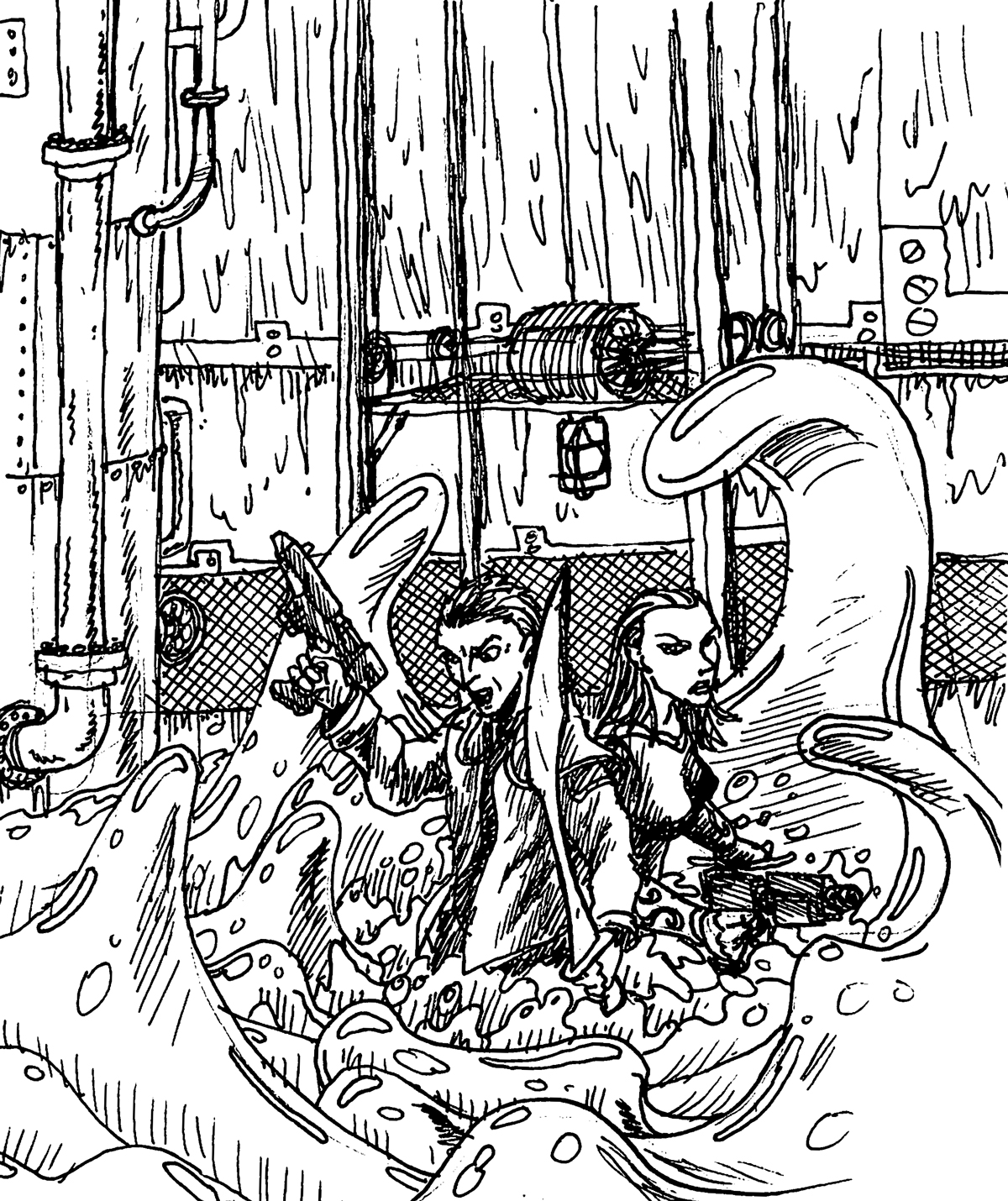
Attack of the Jelly-Blob
Flooded Boiler Room (8)
The large freight doors open onto a freight lift elevated 5m above the floor of this 20m by 12m chamber. There is initially no illumination but the switch for the overhead fixtures can be located easily and activated, producing a weak yellow light. Four large cylindrical tanks stand vertically along the east and west walls, two on each wall. Pipes, pumps, and valves cover nearly every inch of wall space. A staircase on the opposite wall climbs two meters to a landing and an open door. A dark corridor lies beyond the doorway.
This chamber is another boiler room. It is warm and humid. The two tanks on the west wall radiate heat and emit a constant noise of thrumming. The two tanks on the east wall have ruptured, gaping holes blowing metal shards outward from the sides of the steel tanks. The room is flooded with warm water. The water is dark. It appears to be at least a meter deep.
The freight lift is currently elevated. Lowering it takes 24 seconds (2 rounds) resulting in the player characters standing in waist-deep water (neck-deep for jinxes and deru player characters).
(1 square = 2m)
Giant Jelly-Blob
Lurking under the surface of the water is a giant jelly-blob. It will attack anyone that enters the water.A Jelly-blob is an amorphous gelatinous creature the size of an elephant. It is colorless and transparent, rendering it invisible in darkness or under water. Light tends to diffuse and refract through their bodies, making them visible when back-lit. In addition, their slimy membranes are reflective like the surface of a gelatin. Jelly-blobs ooze over any terrain and can squeeze through tiny cracks and fissures, but cannot otherwise change their mass or density. They may also form pseudopods to strike enemies or manipulate simple objects. The gelatin of a jelly-blob is highly acidic, and anyone or anything enveloped by a jelly-blob will take acid damage in addition to asphyxiation damage. Jelly-blobs are not very intelligent, acting purely on stimulus and response.
This jelly-blob was lured into the room by the warm water of the ruptured boiler, under which it rests, hoping to eat any prey that tries to cross through the room. As soon as any player character steps into the water, they immediately feel as if they just stepped into wet sucking mud. They have stepped into the jelly-blob. As a result, the jelly-blob attempts to rise up around the player character and pulls them down onto the floor and towards the center of the room, all the while enveloping, smothering, and dissolving the player character in acidic gelatin until they either die or escape.
Characteristic Roll Average
STR 4D6+6 20
CON 3D6 10-11
SIZ 8D6+40 68
INT 1 1
POW 2D6 7
DEX 1D6 3-4
Move: 2 Hit Points: 44 Damage Bonus: +2D6
Armor: None (see Acid Gelatin below)
Attacks: Pseudopod 50%, 1D6 + db (crushing)
Envelop (see below)
Envelop (see below)
Skills: Hide 85%, Sense Vibration 90%, Stealth 80%
Envelop: Enveloping a target requires the jelly-blob to allocate SIZ points to each intended target. A jelly-blob can attempt to envelop as many targets in a single round as it wants so long as it has SIZ to allocate towards the target. To envelop a target, the jelly-blob must succeed at an opposed check using the jelly-blob’s allocated SIZ vs. the target’s STR, SIZ, or DEX (target’s choice). If the jelly-blob wins, the target is completely enveloped. If the jelly-blob loses, the target is still free and can act normally. It is possible to move through a jelly-blob, but all such movement is halved. An enveloped target is immobilized and all their equipment will take 1D3 damage from the jelly-blob’s digestive acid until dead. In addition, the target is deprived of air and are subject to the rules on Choking, Drowning, and Asphyxiation (BRP page 128). An enveloped victim is normally unable to act. They may struggle to break free each additional combat round by attempting a resistance roll using STR vs the jelly-blob’s allocated SIZ. If an enveloped victim forgoes an escape attempt for a combat round, they may instead attempt a Luck roll. Success allows the victim two options: to have an arm free of the blob such that a friend could grab the victim to try to pull them out the following round; or to have an arm or hand free in order to perform an action. If they choose to have an arm free and a friend tries to help, substitute the friend’s STR for the victim’s STR on the resistance roll to escape. However, if they choose to perform an action, they may attack or use a piece of equipment such as throwing a rope or activating an electric field.
Acid Gelatin: The jelly-blob is composed entirely of a gelatinous acid. Divide the damage from all physical attacks made against it by half. Energy weapons do normal damage.
Immunities: Jelly-blobs are immune to all psychic powers. Jelly-blobs are immune to the following psychic powers—Aura Detection, Emotion Control, Empathy, Mind Blast, Mind Control, Sensitivity, Telepathy, or any other power or effect that affects the mind. Jelly-blobs are immune to the following Ta’oudh powers—Blind, Blinding Bolt, Calm, Disfigure, Disfiguring Bolt, Disrupt, Disrupting Bolt, Enrage, Healing Touch, Hypnotic Gaze, Immobilize, Immobilizing Bolt, Restore, Sense Presence, Stun, Stunning Bolt, or any other power that affects the mind or nervous system of a target.
Monday, March 18, 2013
Norukar, City of the Gods
Norukar, "City of the Gods", also known as Tel-Norukar
The city-state of Norukar lies just off the coast of Targa on the small cluster of islands known as Mnatta. The city is incredibly ancient, believed to predate even the Sdara Vatra. The islands appear to be several steep hills rising from the water like tapered cones. Strange spires, some hundreds of meters tall, sprout from the tops and sides of the hills like giant leafless artificial trees. They are the remnants of an ancient city, though their original purpose is unknown. The hills are terraced and entirely covered by buildings right down to the water-line.
Norukar contains a harbor, walled in and protected by several defensive towers. The buildings of the old quarter are built of stone with large, wide bases and tapering towers reaching sixty to one hundred meters in height, the tallest in pre-contact Cydoria. The newer buildings, constructed in the last twenty years using Rhakadian engineering and technology, are built of lighter concrete and are supported by skeletons of steel. Norukarian towers resemble step pyramids or ziggurats stretched tall and thin and supported by flying buttresses. Some rise as high as two hundred meters into the air. The upper stories of the buildings are connected by sky-bridges so that members of the upper classes can travel from building to building without ever descending to ground level. Small aero-skiffs transport occupants between the upper and lower stories of the towers.
The city skyline is dominated by the aero-ship terminal, a large octagonal stepped tower. It is the tallest structure in Norukar at over three hundred meters tall.
Even before contact with aliens, the technology and design of Norukar, overseen by the secretive Octavium, outshined that of all the other Cydorian city-states. Pre-contact Norukar boasted technological amenities roughly equivalent to those of late nineteenth century North America or Europe with spring-driven elevators, bondrus-drawn street-cars, steel-frame construction, and indoor plumbing.
The hills beneath Norukar are, in actuality, artificial structures built of stone, concrete, steel, and stranger unknown materials. The hills are the remains of a holy city of the Sdara Vatra. Each hill, in its day, was a single giant building in its own right. Over time the outer layers of the buildings weathered, corroded, and decayed. Today, most of the levels have collapsed. The deeper levels hide great domed and vaulted chambers and unexplored passages. This region is known as the “Under-City”. The under-city is inhabited by a race of large semi-aquatic rodents called roshu. There are several access points from the surface to the under-city and many intrepid explorers have braved the journey seeking the lost treasures of the ancients.
Norukar as it appeared during the Age of the Sdara Vatra, followed by Norukar as it appears today, with a cutaway of one of the ancient mountain-ruins.
A view of the skyline of the New Quarter, featuring the new Aero-ship terminal building.
Sunday, March 17, 2013
Update on the "The Blade of Takshaka", aka "The Norukar Adventure"
I just wanted to give an update on the adventure I'm working on, "The Blade of Takshaka". I got a LOT written this weekend! I'm currently working on the Act II dungeon crawl into the bowels of the Undercity of Norukar. After that I'll tackle the Act III masquerade party at a nobleman's penthouse.
Then I'll clean it up and fill in some gaps - special chase rules, NPC stats, random tables, etc.
Here's a preview of the basic plot.
Chapter 1: The Messenger
The player characters are in the city of Norukar and are in a position where they could use some temporary work. Perhaps they are actively seeking employment, calling upon contacts or simply spreading the word that they’re available. Perhaps they are relaxing in between regular jobs, relying on their reputation alone to bring work their way. In any case, their strategy pays off. A messenger seeks out the player characters with an offer of employment.
The messenger, dressed in the livery of a noble house, informs the player characters that they have been summoned to a private meeting with Duke Karn Rylar, Chancellor of the Exchequer of the City of Norukar.
The Duke wishes to hire the player characters to investigate a theft, and is offering a substantial remuneration of 350 golden crowns (+25 wealth) each for the return of the stolen object. An aero-coach limousine is waiting outside to transport them to the duke’s penthouse apartment for additional details. The aero-coach is a luxury model and is richly appointed and fully stocked with the finest libations.
The Office of the Exchequer is responsible for the collection and management of the city’s taxes, tariffs, and duties. The office controls the finances and treasury of the Kingdom of Norukar and is considered one of the most powerful offices within the kingdom. The chancellor is the head of the office and answers directly to Queen Chador. The position of chancellor is equivalent to that of treasurer. Since the chancellor controls the purse-strings of the kingdom, his favor is considered extremely valuable, making him one of the most politically powerful individuals in Norukar.
The Duke wishes to hire the player characters to investigate a theft, and is offering a substantial remuneration of 350 golden crowns (+25 wealth) each for the return of the stolen object. An aero-coach limousine is waiting outside to transport them to the duke’s penthouse apartment for additional details. The aero-coach is a luxury model and is richly appointed and fully stocked with the finest libations.
Assuming the player characters board the limousine, they will be whisked upwards through the soaring towers and buzzing aero-traffic of Norukar. The journey takes only a few minutes as the craft passes through the upper-levels of the stepped-towers, like impossibly-tall ziggurats stretched into the sky, before landing on a platform outside the penthouse apartment atop Tower Kolinor, one of the city’s more opulent towers. Another smaller aero-coach coupe is parked nearby.
The player characters are met at the landing by a well-dressed Jinx, a domestic slave and butler. They are escorted through an ornate entrance manned by two house guards wearing the livery of the duke. They are seated in a sumptuous office filled with curios and relics of bygone civilizations. The butler offers refreshment to anyone wishing one and attends to the needs of the player characters while they wait.
(side-bar table for generating curios)
The Duke Makes an Offer
After a few moments, a man dressed like a noble enters the room and dismisses the slave. The man is in his mid-fifties with a few wrinkles and salt-and-pepper hair. He is wearing a long jacket over a fine silk doublet. He is accompanied by a house guard, an officer with the rank of Major. The major is in his thirties, an obvious military veteran.
“Thank you for coming. My name is Duke Karn Rylar. I am Chancellor of the Exchequer of the City of Norukar. This is Major Nord, my head of household security. As you may have guessed, I am a collector of rare antiquities. Last night, one or more intruders entered into my penthouse and purloined an object from my collection, a sacrificial dagger that once belonged to Takshaka, the First Raga of the Kingdom of Ragana, who ruled southwest Markania five millennia ago. In its place, they left this forgery.” The duke presents an exotic knife of the finest quality with two thin blades like the fangs of a serpent. The knife’s hilt is encrusted with what appear to be jewels and precious stones. Strange curved forms are carved into the blades. The pommel resembles a snake’s rattle. The duke allows any player character who so wishes to inspect the knife closely. “It may look authentic, but to the trained eye, it is an obvious forgery.”
He takes a drink of tea before continuing, “This theft comes at an inopportune time for me. I am in the middle of delicate negotiations with the ambassador of the Kingdom of Ragana, and I planned to present this dagger as a gift to the ambassador.”
“Normally, I would put my own agents on this case, or contact the local constables. However, my own men are occupied on another, more pressing matter, and the local constabulary is under the control of the brother of my chief political rival, Count Garanni. I dare say they would offer me little real assistance on such a trivial matter, especially after the recent budgetary cutbacks, for which they largely hold me accountable.”
“Therefore, I have sought the assistance of, shall we say, independent investigators, off the official records, who can be more discrete. Your services came highly recommended.”
“I need you to recover the stolen artifact before the conclusion of negotiations in a week’s time. If you succeed, you will each be paid 350 golden crowns (+25 Wealth). If you fail, you will each be compensated 10 golden crowns (+5 Wealth) for your time.”
He puts his tea down, opens a drawer in his desk, and removes some papers, “During your investigation, you will carry my personal warrant. This will grant you the temporary authority to temporarily detain individuals for questioning, carry and use restricted weapons and equipment, and access normally forbidden locations. You will be operating under my authority and responsibility.”
“Now that you’ve heard my offer, will accept this mission?”
Allow the player characters to discuss and/or negotiate if they wish.
If they decline the mission, the duke sighs, “That’s too bad. I was hoping I’d be able to employ your services, but I understand. I’ll have Greb transport you wherever you’d like to go. Here is a golden crown each for your trouble (+0 Wealth). I trust you’ll show discretion regarding our meeting. But before you go, can you recommend anyone else who might be up to the task?”
If they accept the mission, the duke slaps his desk in excitement, “Excellent! Major Nord will be able to brief you on the details of the theft and answer any questions.”
Subscribe to:
Posts (Atom)