Monday, April 8, 2013

Maybe I spoke too soon?

Okay, I know I said I was done writing in my last post, but I have decided to add a little more detail on the geography, history, technology, and what life is like in Norukar. Just a few more sections, not too many pages. Plus, I think I'm going to re-design the map of Norukar. I want Norukar to be built in the hollow remnants of an ancient domed city, so I want the "islands" to be more circular with ridge-walls circling the perimeter. 

Here. Have a quickie illustration to tide you over while you are waiting for me to finish.


Sunday, April 7, 2013

The Writing is Almost Done!


I am done with the major portions of the writing of the adventure "The Blade of Takshaka"! All I have left are a few side-bars and some optional NPC stats. After I'm done with that, I'll head to layout and editing, then do some illustrations. So far, the adventure manuscript is 28,480+ words in 63 pages.

I'm still not sure how I'm going to monetize this book, or whether I'm going to give it away in exchange for donations. I originally started writing it as a companion to the Swords of Cydoria book from Chaosium in order to boost sales of that book. However, seeing as how I still haven't been paid for that book and the staff at Chaosium haven't responded to any of my e-mails, I'm reconsidering using it to boost those sales.

Monday, April 1, 2013

The Roshu of Norukar

The Fifth Stratum, Part One: The Roshu Warren
The so-called fifth stratum contains many chambers and corridors that are unexplored and unused by the surface dwellers. This suite of connected chambers has been claimed by a pack of roshu. Roshu are vile semi-aquatic intelligent rats that have developed a primitive sort of society amidst the physical foundations of the city of Norukar. Roshu are not actively hostile towards humans or other surface-dwellers, but they are opportunistic and have, on occasion, stolen human children to serve as slaves or food.  Roshu have no language as humans understand it, but communicate using barking sounds, squeaks, growls, body language, and simple hand-signs.
The roshu of this warren will at first try to turn any interlopers away through warning barks and threatening displays. If pressed, they will defend their warren to the death. If the player characters show that they wish to parley or trade, the roshu will warily indicate acceptance and will meet peaceably in the outer guard room. If any player characters ask about the cult, perhaps showing the poison daggers or the robes, the roshu traders will indicate understanding and will offer to lead the player characters through a secret tunnel to the heart of the cult temple, bypassing the guards, in exchange for barter.

Roshu

Roshu Warriors

Roshu warriors are trained and armed for battle. They defend the warren and go on raiding parties to the upper strata.
Characteristic      Roll                        Average
STR                        2D6                        7
CON                       2D6                        7
SIZ                         2D6                        7
INT                        2D6+6                    13
POW                      3D6                        10-11
DEX                       3D6                        10-11
APP                        1D6+2                    5-6
Move: 10              Hit Points: 7         Damage Bonus: -1D4
Armor: Usually none, though some Roshu warriors wear 2-point of hide or leather with a light helmet.
Attacks: Bite 40%, 1D3 + db
Claw 25%, 1D3 + db
Short Spear 35%, 1D6 + 1 + db, warriors only
Short Sword 35%, 1D6 + 1 + db, warriors only
Skills: Dodge 40%, Hide 40%, Fine Manipulation 40%, Listen 65%, Sense 95%, Sleight of Hand 50%, Stealth 40%, Swim 100%
Diseased Bite: The bite of a Roshu harbors communicable diseases. Treat as the Disease Carrier minor mutation (BRP page 105) with a POT of 2D6 (rolled with each contact).

Hisser (Giant Cockroach)

The cockroaches of the Norukarian Under-City, known as Hissers, can reach up to a meter in length. The roshu have domesticated and trained these massive cockroaches to serve as watchdogs and attack beasts.
Characteristic      Roll                        Average
STR                        2D6+12                 19
CON                       3D6                        10-11
SIZ                         2D6+3                    10
INT                        2                              2
POW                      1D6+6                    9-10
DEX                       3D6+6                    16-17
APP                        1D6                        3-4
Move: 4                 Hit Points: 14-15                Damage Bonus: none
Armor: 4-point chitin
Attacks: Bite 55%, 1D8 + db
Acid Spit 40%, 1D6 + acid (see Acid Spit below)
Skills: Dodge 40%, Hide 80%, Stealth 60%
Acid Spit: The hisser can spit an acidic attack up to 6m at a target once every ten minutes (1 turn). Any target hit with the acid spit attack will take an additional 1D3-1 damage per round (see Acid, BRP page 211).

Roshu Giant

Approximately one out of every twenty roshu is born with a mutation that causes gigantism. These specimens grow to a height of up to three meters. They are massive, brutish, and dumb. They are easily tamed and trained by roshu slave overseers and are put to work as laborers and shock troops.
Characteristic      Roll                        Average
STR                        3D6+12                 22-23
CON                       2D6+9                    16
SIZ                         3D6+12                 22-23
INT                        1D6+3                    6
POW                      2D6                        7
DEX                       3D6                        10-11
APP                        1D6+2                    5-6
Move: 12              Hit Points: 19-20                Damage Bonus: +2D6
Armor: Usually none, though some roshu giants wear 2-point of hide or leather with a light helmet.
Attacks: Bite 40%, 1D3 + db
Claw 25%, 1D3 + db
Grapple 65%,
Skills: Dodge 40%, Listen 35%, Sense 30%, Spot 35%, Track 55%
Diseased Bite: The bite of a Roshu harbors communicable diseases. Treat as the Disease Carrier minor mutation (BRP page 105) with a POT of 2D6 (rolled with each contact).

Slash-Face, the Roshu Sergeant

Slash-Face is the leader of a pack of roshu warriors. He is an experienced survivor, a canny combatant, and a trusted battle leader.
STR 9    CON 11   SIZ 7    INT 15  POW 14  DEX 13 APP 4
Move: 10              Hit Points: 8         Damage Bonus: -1D4
Armor: 2-point hide and light helmet
Attacks: Bite 40%, 1D3 + db
Claw 25%, 1D3 + db
Short Sword 45%, 1D6 + 1 + db, warriors only
Skills: Dodge 60%, Hide 50%, Fine Manipulation 40%, Listen 70%, Sense 95%, Sleight of Hand 60%, Stealth 65%, Swim 100%
Diseased Bite: The bite of a Roshu harbors communicable diseases. Treat as the Disease Carrier minor mutation (BRP page 105) with a POT of 2D6 (rolled with each contact).

Roshu Queen

The queen of the roshu is generally a non-combatant, preferring instead to let her guards defend her person. However, if cornered, she will fight with animal ferocity.
Characteristic      Roll                        Average
STR                        2D6                        7
CON                       3D6                        10-11
SIZ                         3D6                        10-11
INT                        2D6+6                    13
POW                      3D6                        10-11
DEX                       2D6                        7
APP                        1D6+1                    4-5
Move: 4                 Hit Points: 8-9     Damage Bonus: None
Armor: None
Attacks: Bite 40%, 1D3 + db
Claw 25%, 1D3 + db
Skills: Dodge 40%, Hide 40%, Fine Manipulation 40%, Listen 65%, Sense 95%, Sleight of Hand 50%, Stealth 40%, Swim 100%
Diseased Bite: The bite of a Roshu harbors communicable diseases. Treat as the Disease Carrier minor mutation (BRP page 105) with a POT of 2D6 (rolled with each contact).
Monday, March 25, 2013

A New Word for "Biomancy"

I've never been happy with the term "Biomancer" to describe the wizard who specializes in creating mutagenic potions or breeding/creating bizarre chimeraic beasts.

My problem with biomancer is two-fold:
1. bio- is just too scientific
2. -mancer refers to diviners, not workers of practical "magic".

I posted the question to RPG.net recently and got some great suggestions. My favorites were "teraturge" and "marlane".

"Teraturge" appeals to me for the same reason I chose "terat" to mean "mutant monster". It comes from the Greek word for monster and has the added benefit of being the same word: a teraturge is someone who makes terats.

I then extrapolated to also get the more benign "mutaturge", someone who makes mutants. It removes the inherent negative implication of creating "monsters" because not all mutants created by mutagenic potions are horrible, and the members of the Society of Twin Serpents are trying to change the public perception of all "teraturges" as "mad scientists". So maybe the general term is "teraturge" but the forward thinking members of the Society are trying to push the term "mutaturge" instead.

I also really like "merlane", which apparenlty comes from an issue of Dragon Magazine. It is appropriately archaic sounding, the kind of work Jack Vance would have used. I can't find any etymology for it and I would prefer to know I'm using an actual archaic work and not one coined by the author of that article to refer to a specific type of wizard.

Anyway, work proceeds apace on "The Blade of Takshaka". I'm deep into the Roshu Warrens now, which shouldn't take long. Then I'll tackle the Temple of Anaka.

Thursday, March 21, 2013

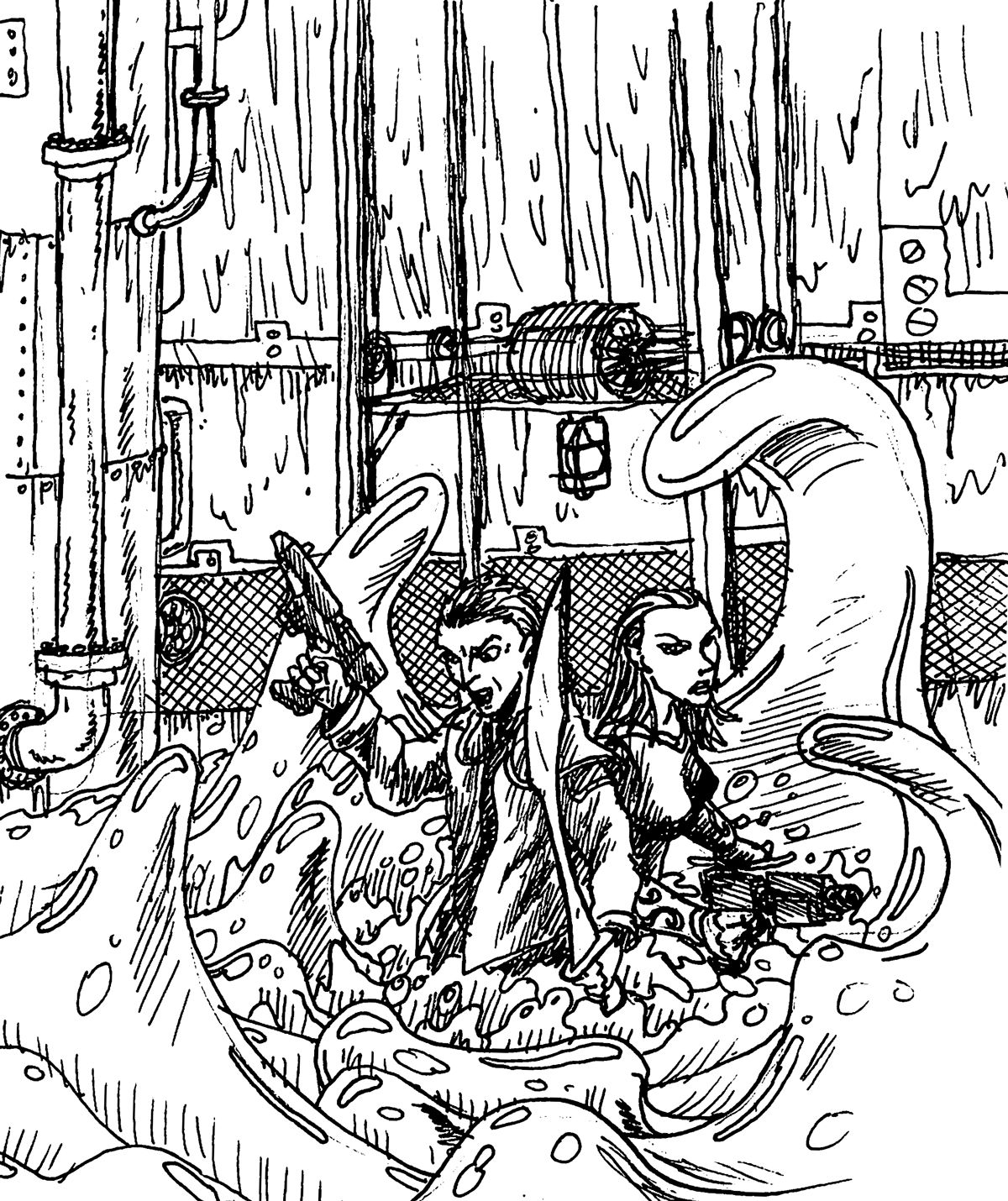
Attack of the Jelly-Blob


Flooded Boiler Room (8)

The large freight doors open onto a freight lift elevated 5m above the floor of this 20m by 12m chamber. There is initially no illumination but the switch for the overhead fixtures can be located easily and activated, producing a weak yellow light. Four large cylindrical tanks stand vertically along the east and west walls, two on each wall. Pipes, pumps, and valves cover nearly every inch of wall space. A staircase on the opposite wall climbs two meters to a landing and an open door. A dark corridor lies beyond the doorway.

This chamber is another boiler room. It is warm and humid. The two tanks on the west wall radiate heat and emit a constant noise of thrumming. The two tanks on the east wall have ruptured, gaping holes blowing metal shards outward from the sides of the steel tanks. The room is flooded with warm water. The water is dark. It appears to be at least a meter deep.
The freight lift is currently elevated. Lowering it takes 24 seconds (2 rounds) resulting in the player characters standing in waist-deep water (neck-deep for jinxes and deru player characters).
(1 square = 2m)


Giant Jelly-Blob

Lurking under the surface of the water is a giant jelly-blob. It will attack anyone that enters the water.A Jelly-blob is an amorphous gelatinous creature the size of an elephant. It is colorless and transparent, rendering it invisible in darkness or under water. Light tends to diffuse and refract through their bodies, making them visible when back-lit. In addition, their slimy membranes are reflective like the surface of a gelatin. Jelly-blobs ooze over any terrain and can squeeze through tiny cracks and fissures, but cannot otherwise change their mass or density. They may also form pseudopods to strike enemies or manipulate simple objects. The gelatin of a jelly-blob is highly acidic, and anyone or anything enveloped by a jelly-blob will take acid damage in addition to asphyxiation damage. Jelly-blobs are not very intelligent, acting purely on stimulus and response.

This jelly-blob was lured into the room by the warm water of the ruptured boiler, under which it rests, hoping to eat any prey that tries to cross through the room. As soon as any player character steps into the water, they immediately feel as if they just stepped into wet sucking mud. They have stepped into the jelly-blob. As a result, the jelly-blob attempts to rise up around the player character and pulls them down onto the floor and towards the center of the room, all the while enveloping, smothering, and dissolving the player character in acidic gelatin until they either die or escape.

Characteristic        Roll                         Average
STR                        4D6+6                    20
CON                      3D6                         10-11
SIZ                         8D6+40                  68
INT                        1                              1
POW                      2D6                         7
DEX                       1D6                         3-4
Move: 2                  Hit Points: 44       Damage Bonus: +2D6

Armor: None (see Acid Gelatin below)

Attacks:  Pseudopod 50%, 1D6 + db (crushing)
    Envelop (see below)

Skills: Hide 85%, Sense Vibration 90%, Stealth 80%

Envelop: Enveloping a target requires the jelly-blob to allocate SIZ points to each intended target. A jelly-blob can attempt to envelop as many targets in a single round as it wants so long as it has SIZ to allocate towards the target. To envelop a target, the jelly-blob must succeed at an opposed check using the jelly-blob’s allocated SIZ vs. the target’s STR, SIZ, or DEX (target’s choice). If the jelly-blob wins, the target is completely enveloped. If the jelly-blob loses, the target is still free and can act normally. It is possible to move through a jelly-blob, but all such movement is halved. An enveloped target is immobilized and all their equipment will take 1D3 damage from the jelly-blob’s digestive acid until dead. In addition, the target is deprived of air and are subject to the rules on Choking, Drowning, and Asphyxiation (BRP page 128). An enveloped victim is normally unable to act. They may struggle to break free each additional combat round by attempting a resistance roll using STR vs the jelly-blob’s allocated SIZ. If an enveloped victim forgoes an escape attempt for a combat round, they may instead attempt a Luck roll. Success allows the victim two options: to have an arm free of the blob such that a friend could grab the victim to try to pull them out the following round; or to have an arm or hand free in order to perform an action. If they choose to have an arm free and a friend tries to help, substitute the friend’s STR for the victim’s STR on the resistance roll to escape. However, if they choose to perform an action, they may attack or use a piece of equipment such as throwing a rope or activating an electric field.

Acid Gelatin: The jelly-blob is composed entirely of a gelatinous acid. Divide the damage from all physical attacks made against it by half. Energy weapons do normal damage.

Immunities: Jelly-blobs are immune to all psychic powers. Jelly-blobs are immune to the following psychic powers—Aura Detection, Emotion Control, Empathy, Mind Blast, Mind Control, Sensitivity, Telepathy, or any other power or effect that affects the mind. Jelly-blobs are immune to the following Ta’oudh powers—Blind, Blinding Bolt, Calm, Disfigure, Disfiguring Bolt,  Disrupt, Disrupting Bolt, Enrage, Healing Touch, Hypnotic Gaze, Immobilize, Immobilizing Bolt, Restore, Sense Presence, Stun, Stunning Bolt, or any other power that affects the mind or nervous system of a target.

Tuesday, March 19, 2013

The Loracz (a lost illustration)

No, not the Dr. Seuss character. The Loracz is a race of humanoid carnivorous insects that dwell in caves under the Loka Loka mountains in Markania. They are primitive and like to eat people and are generally not very hospitable. They are known to range down from the mountains at night to steal human children for food.

The Loracz are detailed in the Swords of Cydoria book, but I had to cut the illustration out for space.

I based the Loracz on the Ovians from the original Battlestar Galactica series.


Monday, March 18, 2013

Norukar, City of the Gods

Norukar, "City of the Gods", also known as Tel-Norukar

The city-state of Norukar lies just off the coast of Targa on the small cluster of islands known as Mnatta. The city is incredibly ancient, believed to predate even the Sdara Vatra. The islands appear to be several steep hills rising from the water like tapered cones. Strange spires, some hundreds of meters tall, sprout from the tops and sides of the hills like giant leafless artificial trees. They are the remnants of an ancient city, though their original purpose is unknown. The hills are terraced and entirely covered by buildings right down to the water-line.

Norukar contains a harbor, walled in and protected by several defensive towers. The buildings of the old quarter are built of stone with large, wide bases and tapering towers reaching sixty to one hundred meters in height, the tallest in pre-contact Cydoria. The newer buildings, constructed in the last twenty years using Rhakadian engineering and technology, are built of lighter concrete and are supported by skeletons of steel. Norukarian towers resemble step pyramids or ziggurats stretched tall and thin and supported by flying buttresses. Some rise as high as two hundred meters into the air. The upper stories of the buildings are connected by sky-bridges so that members of the upper classes can travel from building to building without ever descending to ground level. Small aero-skiffs transport occupants between the upper and lower stories of the towers.

The city skyline is dominated by the aero-ship terminal, a large octagonal stepped tower. It is the tallest structure in Norukar at over three hundred meters tall.

Even before contact with aliens, the technology and design of Norukar, overseen by the secretive Octavium, outshined that of all the other Cydorian city-states. Pre-contact Norukar boasted technological amenities roughly equivalent to those of late nineteenth century North America or Europe with spring-driven elevators, bondrus-drawn street-cars, steel-frame construction, and indoor plumbing.

The hills beneath Norukar are, in actuality, artificial structures built of stone, concrete, steel, and stranger unknown materials. The hills are the remains of a holy city of the Sdara Vatra. Each hill, in its day, was a single giant building in its own right. Over time the outer layers of the buildings weathered, corroded, and decayed. Today, most of the levels have collapsed. The deeper levels hide great domed and vaulted chambers and unexplored passages. This region is known as the “Under-City”. The under-city is inhabited by a race of large semi-aquatic rodents called roshu. There are several access points from the surface to the under-city and many intrepid explorers have braved the journey seeking the lost treasures of the ancients.


Norukar as it appeared during the Age of the Sdara Vatra, followed by Norukar as it appears today, with a cutaway of one of the ancient mountain-ruins.

A view of the skyline of the New Quarter, featuring the new Aero-ship terminal building.